

From garage to brewery
Bierbrouwerij De 3 Horne is a craft brewery devoted to the quality and variety of its speciality beers.
The philosophy: a beer gets its aroma, colour, taste and body from natural ingredients, and the character of the yeast comes second. Only that way do you make a beer that lives up to what its ingredients promise.
The beers are generally lightly bitter and slightly sweet, rounded off with a fruity or spicy undertone. Because the brewery is set up to be very flexible, it can respond directly to a customer's particular wishes.
BIER MOET BIER BLIJVEN!
"Beer should stay beer": the brewer's motto, to this day.
-
The beginning
First, the permits
Before brewery "Wittekop" could start, the brewer needed permission from his employer, the West Brabant water board: was there a conflict of interest? After a lively conversation it turned out to be no problem at all, as long as it stayed a hobby.
Then the real work began. An environmental permit from the municipality of Loon op Zand, the guidelines of the food safety authority, a notification to the water board, registration with the Chamber of Commerce, a VAT number, and finally a customs licence for an excise warehouse. After a few months of meetings and applications, everything was signed and sealed.
-
1990 · Starting up
Brewery "Wittekop", 6 m²
The name came from home: "Witte kop" (white head) was the nickname of the brewer's son, who had very fair blond hair as a child.
The brewery was built in a partitioned-off corner of the garage, all of 6 m². Inside went a complete brewing installation, built by the brewer himself.
Within two months a registered letter arrived from the Slaghmuylder brewery in Belgium: the name "Wittekop" was too close to their Witkap Pater and could no longer be used.
So it became brewery "De 3 Horne". The name comes from the Van Horne family, medieval lords of the Loon op Zand area. The logo carries the Van Horne horns and the familiar Brabant flag.
Beer was brewed in the evenings, 13 crates a week. That soon proved too little, and before long there was brewing four times a week.
- 135 litres per brew
- 35 to 70 hectolitres a year
Read more: the garage brewhouse
- 1 brew kettle with 2 heating elements of 3.3 kW, 135 litres per brew
- 1 lauter tun of 200 litres per brew
- 2 fermentation vessels of 80 litres
- 2 conditioning vessels of 80 litres
- 1 filler
- 1 small kitchen unit with hot and cold water
- 2 electrical circuits of 16 A
-
1992 to 1993 · Moving on
To the Marktstraat
Demand for speciality beer grew explosively, so a bigger building was needed: a former shoe factory, of the kind built in many Kaatsheuvel back gardens in the 1950s. It needed a lot of work, but after half a year of toil the new equipment went in, in 1993.
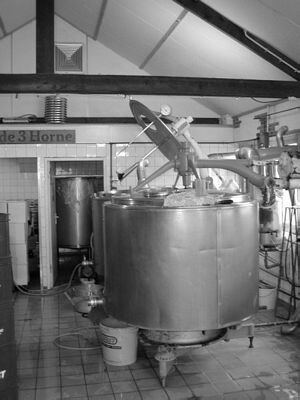
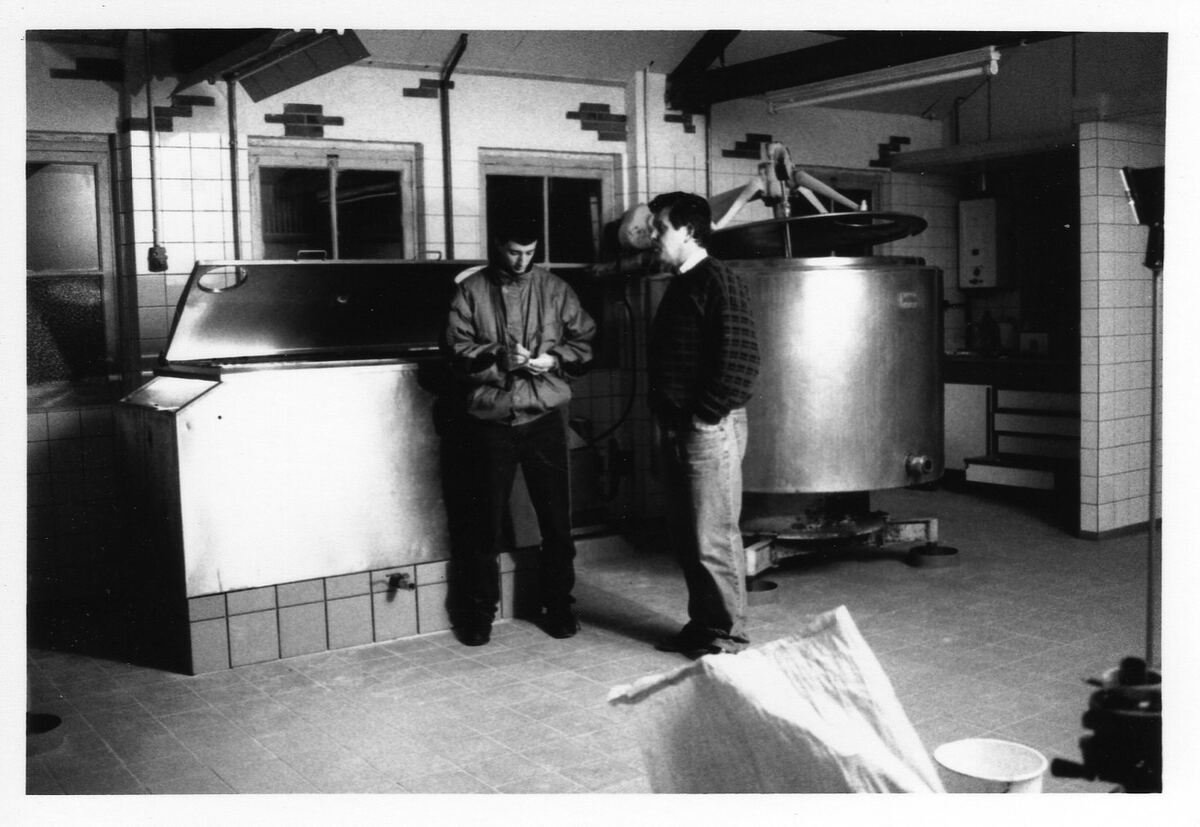
That equipment had a past of its own. The two big brew kettles once cooked tomato juice for Hero, and the bottle capper came from the closed Brouwerij De Kroon.
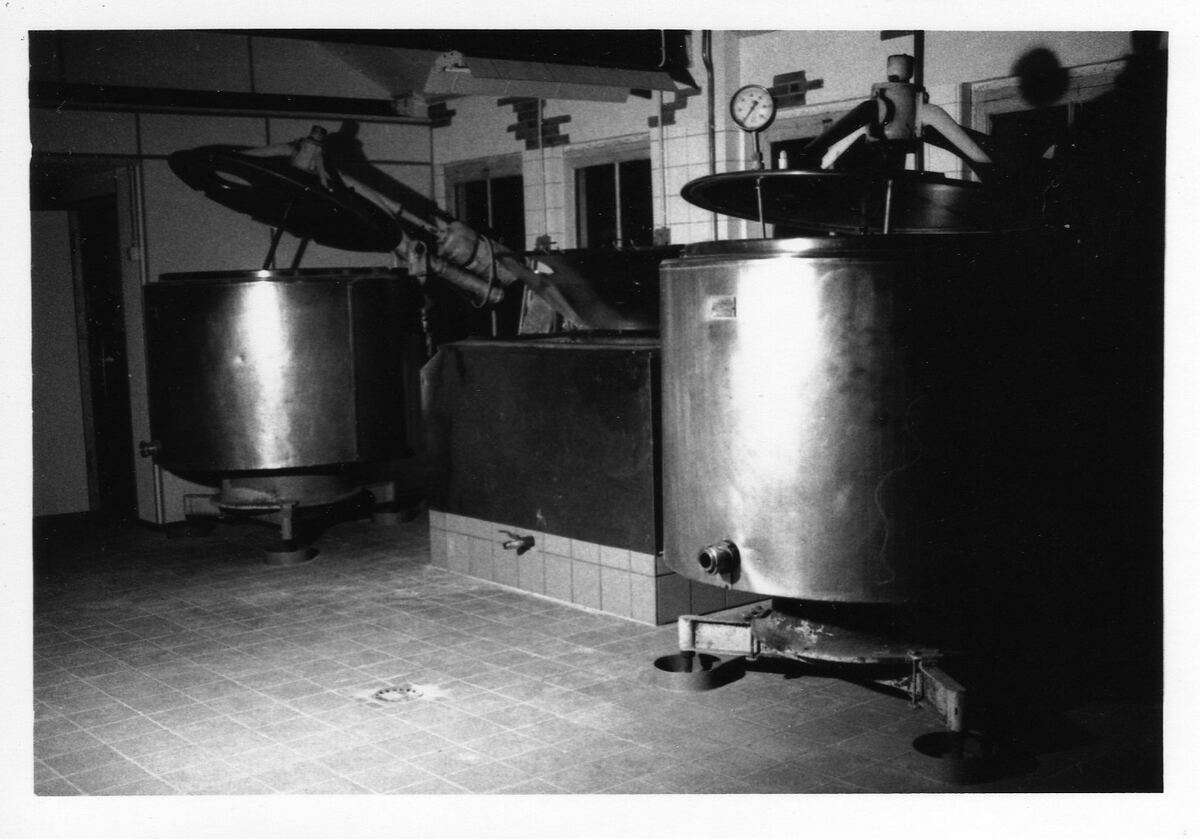
The building covers 170 m², with 90 m² of brewery and 30 m² of shop for home brewers ('t Gruithuys). Over the years production grew from 70 to 600 hectolitres a year.
- 2 brew kettles of 750 litres
- 170 m²
- 600 hectolitres a year
Read more: the Marktstraat brewhouse
- 2 brew kettles of 750 litres per brew each
- 1 lauter tun of 1000 litres per brew
- 5 stainless steel fermentation and conditioning tanks of 900 litres
- 4 stainless steel conditioning tanks of 750 litres
- 1 universal filler: 33 cl, 1200 per hour; 75 cl, 500 per hour; 20-litre kegs
- 1 keg washer, 20 kegs per hour
- 1 hand capper for every bottle size except 33 cl
- 1 seven-head capper for 33 cl, 4000 bottles per hour
- 1 labelling machine
- 1 bottle washer, 400 to 4000 bottles per hour
-
2001 · 't Gruithuys
A shop for home brewers
In 2001 a small shop opened inside the brewery: 't Gruithuys, with everything home brewers and wine makers need, from malt and hops to crown caps. More about 't Gruithuys.
-
2019 · Grape beer
Grapes from local gardens
In 2019 the brewery asked residents of the municipality of Loon op Zand for grapes from their own gardens. It hoped for 1000 kilos and got almost twice that: ninety people, most of them from the municipality itself, brought 1875 kilos of white and red grapes. That made 1800 litres of beer: Hornse Heerlykheid, a quadrupel. Every ten kilos earned a 75 cl bottle in return.
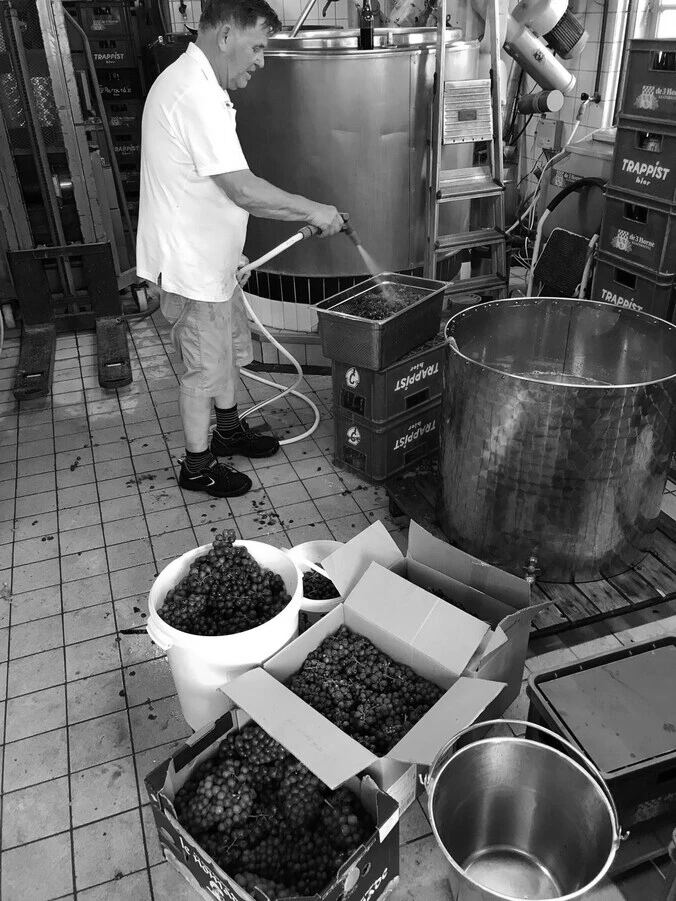
The beer was meant for a local club. A notary drew the Koninklijk Erkende Harmonie Kaatsheuvel, the village wind band, from the clubs that had entered, and it was given 1500 litres to sell. The band received the first bottles on 14 December 2019.
-
The future
Who will take over?
As the brewery has no successor, its continuity may become a problem in the future. A plan to secure its survival is already being worked out, and it may well become a creative solution.